Connected lighting is jump-starting home automation
I’ve been working on the Philips hue lightbulbs for more than a year now, specifically on the internet connectivity part. And I’ve found that hue is the start of a much bigger movement. Let me whow you.
Remote control
The hue kit that you can buy at the Apple store has a few built-in remote features. First, there’s the basic “remote control” from outside of your house. Secondly there’s geofencing. By setting a perimeter around your house, you can let your app turn the lights on before you even open the front door. And thirdly, there’s IFTTT, which lets you create triggers on internet events to control your lights. For example, you can have the lamp in your hallway turn blue if it’s going to rain and you should bring your umbrella when you go out.
Build your own apps
Philips also opened up the internal API of the hue bridge to the public, allowing you to build your own apps. This of course resulted in loads of different interfaces on various devices.
But it also sparked more creative minds, like the hue disco app, that reacts to sounds via the microphone, and you can create your own in-home disco lighting. Or the goldee app that uses dynamic scenes, where the light gradually and slightly changes color over time, to mimic a more natural lighting.
Combining with other devices
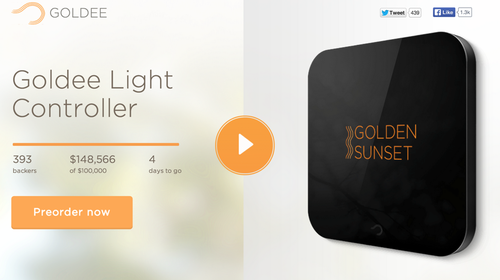
But that internal API also enables your lights to talk to other devices in your house. The goldee box is a wall switch that can control your hue (or lifx, or ilumi) lighting, and improves your interaction with lighting without the need of a smartphone.
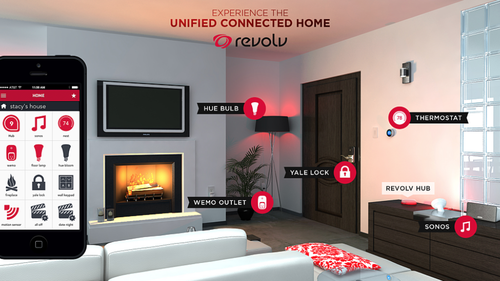
Take it a step further and you arrive at the revolv. It’s a box that you install somewhere in your house, and it can talk multiple channels. Not just lighting, but also your wemo outlet, yale lock, sonos sound system and others. And this thing is already in production, I have one sitting next to me on my desk at Q42.
The future
These things all exist today. Look how far we’ve gotten. But there’s still a bright future ahead for home automation. The nest thermostat and nest secure are doing a pretty good job at presence awareness and more importantly, presence prediction. If your house knows you’re going to need a warmed-up house, it can arrange that for you. Same goes for lights, music, etc. And it’s not just your house that’s connected to this ecosystem. The Tesla Model S for instance, also has an API.
So hue is really at the start of a bigger ecosystem of connected products. By being an open system, it’s using that ecosystem to make itself more useful. And I’m excited to be a part of that.